When the Report Reveals More Than You Expected: Incidental Findings on a Private Venous Ultrasound
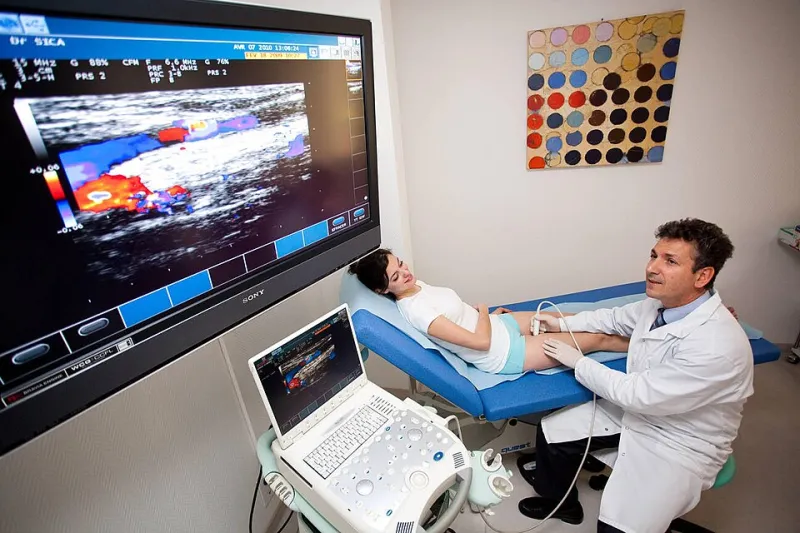
Photo: Goleisureintl, CC BY 4.0, via Wikimedia Commons
The result you were not looking for
A private venous ultrasound is usually booked with a specific purpose: to look at the veins of the neck, to check for reflux, or to answer a question raised in a consultation. Occasionally the sonographer sees something else along the way. A valve that closes differently from the textbook description. A duplicated vessel. A segment that looks narrow. Sometimes a shadow that raises the possibility of clot.
These are called incidental findings. The term is neutral. It describes how a result came to light, not how serious it is. Many incidental findings are harmless variations that would never have caused a symptom and never will. A smaller number matter a great deal and need prompt attention through the NHS. The difficulty for patients is that a private report rarely makes that distinction clear, and the appointment that follows can feel like a sales conversation rather than a clinical one.
This article sets out a practical approach. It is general information, not medical advice, and it does not replace an assessment by a clinician who has examined you.
Why ultrasound produces findings of uncertain meaning
Ultrasound is operator-dependent. The image quality, the angle of the probe, the position of your head or arm, whether you were asked to hold your breath, and the criteria the sonographer applied all shape what appears in the report. Venous anatomy is also genuinely variable between individuals. Studies of healthy volunteers have repeatedly shown that narrowings, valve irregularities, and duplicated or absent segments occur in people with no symptoms at all.
That does not make the scan worthless. It means a finding needs a context before it becomes a diagnosis. The useful question is not "is there an abnormality?" but "is there an abnormality that plausibly explains this person's symptoms, and does it change what we would do?"
The kinds of finding you may encounter
Broadly, incidental results fall into four groups.
Anatomical variants. Duplicated veins, unusual drainage patterns, and valves positioned differently from the common picture. These are usually described as normal variants and rarely require anything beyond a note in your records.
Valve changes and reflux. A valve that does not close fully may allow blood to flow backwards. Whether that matters depends on how it was measured, in what position, and whether it correlates with your symptoms. Reflux criteria used in research settings are specific, and a report that says "reflux noted" without measurements is difficult to interpret.
Narrowings without evidence of obstruction. A segment may appear narrow on imaging without restricting flow. This distinction is important, because a narrowing that does not obstruct is not automatically a problem to be fixed.
Unexpected clot concerns. This is the group that warrants the fastest response. If a report raises the possibility of thrombosis, or if you develop new swelling, pain, warmth, redness, or breathlessness, contact NHS 111 or your GP urgently, and call 999 if breathing difficulty is severe. Do not wait for a private follow-up appointment.
Asking for a report you can actually use
A verbal summary at the end of a scan is not enough. Request the written report and the images, and ask for the following to be included if they are not already.
- The name and role of the person who performed and interpreted the scan.
- The specific measurements behind any description of narrowing or reflux, including the criteria used.
- Whether the finding was present on provocation, such as a Valsalva manoeuvre or positional change.
- A plain statement of whether the finding is considered a normal variant, of uncertain significance, or requiring follow-up.
- A clear recommendation, or an explicit statement that no treatment is recommended.
You are entitled to ask for this in writing before you make any decision about further procedures. A clinic that cannot provide it is telling you something useful.
The NHS follow-up question
Ask directly: "Which of these findings, if any, would you refer to the NHS, and to which service?" A reputable clinician will answer without hesitation. Some findings need no referral. Some, such as a suspected clot, need same-day assessment. Others may warrant a routine vascular or haematology opinion through your GP.
Your GP is the right starting point for that referral. Take the written report and the images, and explain what prompted the scan. NHS vascular services assess and treat venous disease on clinical grounds, and a private report is a piece of information within that assessment, not a substitute for it.
Resisting the pressure to decide quickly
It is common for a private appointment to end with a proposed procedure and a request for a deposit. There is no clinical emergency that requires you to consent to a venous intervention on the day of a scan. Legitimate practice allows time for reflection, for a second opinion, and for discussion with your GP.
Be cautious if a finding is presented as the explanation for long-standing neurological symptoms. The evidence for venoplasty or stenting as a treatment for multiple sclerosis remains insufficient, and CCSVI is not an established diagnosis. A scan finding should not be allowed to carry that weight on its own.
Ask for the report, ask what the finding means in your case, ask who else should see it, and take the time you need. A finding that is genuinely urgent will still be urgent tomorrow, and it should be handled through the NHS without delay rather than through a private sales pathway.